
House of the Dragon or Fire & Blood
Is House of the Dragon faithful to George R. R. Martin's books? From the friendship between Alicent and Rhaenyra to the dragons of the Dance, discover the major differences between the HBO series and Fire & Blood, up to Season 3.


The essentials in 30 seconds
- Is the series faithful? It follows the broad strokes of the Dance of the Dragons, but takes many liberties
- The adapted book Fire & Blood, a historical chronicle published by George R. R. Martin in 2018
- The biggest changes Alicent and Rhaenyra's childhood friendship, Lucerys's death, Blood and Cheese without Maelor, Rhaena in place of Nettles
- In season 3 The battles of the Gullet and Tumbleton reimagined, and the prophecy of the Prince That Was Promised highlighted
- The author's opinion George R. R. Martin criticized the removal of Maelor in September 2024
- Should you read the book? Not to follow the series, but it reveals the end of the Dance of the Dragons
Without revealing the outcome of the Dance of the Dragons. The sources are listed at the end of the article.
Last updated: November 23, 2026
Is House of the Dragon faithful to George R. R. Martin's books? Since its first broadcast in 2022, the prequel to Game of Thrones has fascinated and divided fans of the Westeros universe alike. While the HBO series follows the broad strokes of the Dance of the Dragons, the terrible civil war pitting the members of House Targaryen against each other, it also takes many liberties with the original work.
Removed characters, transformed relationships, dragons assigned to other riders, and reimagined battles: the differences between House of the Dragon and the book Fire & Blood are sometimes far greater than one might imagine.
And with the third season released in the summer of 2026, these changes have taken on a new dimension.
So, what are the main differences between the series House of the Dragon and the books? Why did HBO change certain events? And what does George R. R. Martin think of this adaptation?
Let's discover the most striking changes, without revealing the outcome of the Dance of the Dragons.
Table of contents15 parts
Is House of the Dragon adapted from a book?
Unlike Game of Thrones, which adapts the literary saga A Song of Ice and Fire, House of the Dragon is primarily inspired by Fire & Blood (Fire & Blood), published by George R. R. Martin in 2018.
This book tells the history of the Targaryen dynasty, from Aegon the Conqueror's conquest of Westeros to the reigns of his descendants.
The series focuses on one of the most tragic episodes in this history: the Dance of the Dragons, a succession war pitting Rhaenyra Targaryen against her half-brother Aegon II.
Fire & Blood: a history book rather than a traditional novel
The main difference between House of the Dragon and Fire & Blood lies in how they tell the events.
The book is presented as a history chronicle written by a maester of Westeros. The events are reported based on sometimes contradictory testimonies, documents, and accounts.
Among the sources used are Septon Eustace, Maester Aemon, and Mushroom, a court jester whose testimonies are often particularly scandalous.
The reader must therefore regularly ask themselves which version of events is the most credible.
The HBO series, on the other hand, must show a specific story on screen. The writers thus chose to interpret certain events, develop the characters' motivations, and sometimes directly change the facts told in the book.
This particularity explains some of the differences between the two works, but not necessarily all of them.
Alicent and Rhaenyra: a friendship invented for House of the Dragon
One of the most important changes concerns the relationship between Alicent Hightower and Rhaenyra Targaryen.
In the series, the two young women are presented as particularly close childhood friends.
Their relationship gradually deteriorates when Alicent marries King Viserys I, Rhaenyra's father, and then gives birth to heirs who could challenge the succession.
This former friendship is one of the main emotional drivers of the series.
In the book, Alicent is older than Rhaenyra
In Fire & Blood, Alicent is about nine years older than Rhaenyra.
The two characters are not presented as inseparable childhood friends.
Their rivalry is primarily linked to their families' political ambitions and the question of succession to the Iron Throne.
By transforming their relationship, HBO chose to give the civil war a more personal dimension.
The Dance of the Dragons thus becomes not only a conflict between two factions, but also the story of a broken friendship.
This change considerably influences the decisions made by both characters, especially in the second and third seasons.
Viserys Targaryen: a much more developed character in the series
King Viserys I is another example of a character deeply enriched by the television adaptation.
In Fire & Blood, he appears primarily as a relatively peaceful ruler whose succession decisions help prepare the conflict.
The series gives him a more tragic dimension.
Played by Paddy Considine, Viserys suffers from a progressive illness that deteriorates his physical condition throughout the episodes.
His efforts to preserve the unity of his family also become one of the main themes of the first season.
Does Viserys's illness exist in the books?
The book mentions the king's health problems, but does not describe the same spectacular physical deterioration as the series.
The wounds, amputations, and Viserys's almost cadaverous appearance are important choices of the adaptation.
They visually reinforce the king's decline and, symbolically, that of the Targaryens' political stability.
Lucerys's death: an accident in the series, a murder in the book?
Lucerys Velaryon's death marks one of the major turning points of the first season.
In the series, Aemond pursues Lucerys on the back of Vhagar, while the young prince tries to escape with Arrax.
The situation escalates when the dragons escape the control of their riders.
Vhagar eventually kills Arrax and Lucerys, causing even Aemond himself to be stunned.
A much more ambiguous intention in Fire & Blood
In the book, Aemond is presented as responsible for Lucerys's death, but the chroniclers obviously do not have direct access to his thoughts.
The series therefore chooses a particular interpretation: that of a confrontation that turns into a tragedy because dragons are not merely obedient weapons.
This decision reinforces the idea that even the Targaryens never fully control their creatures.
It also transforms Aemond's moral responsibility, turning an event presented as a deliberate act in the chronicles into a catastrophe he had not fully anticipated.
Blood and Cheese: why did HBO change this scene?
The Blood and Cheese episode, or Blood and Cheese, is one of the darkest events of the Dance of the Dragons.
In the second season, two assassins enter the royal apartments to kill a member of Aegon II's family.
Not finding their initial target, they assassinate young Jaehaerys, the son of Aegon and Helaena.
In the book, Helaena must choose between her children
The version in Fire & Blood is significantly different.
Helaena is faced with a particularly cruel choice between her children.
Prince Maelor, her youngest son, is present in the book, while he was removed from the second season of the series.
This absence profoundly changes the scene and its emotional consequences.
George R. R. Martin also publicly criticized this decision in September 2024, believing that Maelor's disappearance risked having major consequences for the rest of the story.
The third season confirmed that the writers chose to reorganize several events related to Helaena's fate.
Rhaena and Sheepstealer: the biggest change regarding dragons
Among the most important differences between House of the Dragon and Fire & Blood, the story of the wild dragon Sheepstealer holds a special place.
In the book, this dragon is tamed by a young woman named Ortye, or Nettles in English.
She comes from modest origins, and her possible Valyrian ancestry remains uncertain.
She manages to win Sheepstealer's trust by regularly bringing him sheep.
Her story thus challenges certain ideas about the link between Targaryen blood and the ability to ride a dragon.
In the series, Nettles is replaced by Rhaena Targaryen
HBO chose to remove Nettles and entrust part of her storyline to Rhaena Targaryen, Daemon's daughter.
This change, started at the end of the second season, takes on considerable importance in the third.
Rhaena manages to bond with the wild dragon, but her lack of experience leads to dramatic consequences during the battle of the Gullet.
This change also transforms the relationships between Rhaena, Daemon, and Rhaenyra.
In an interview with IGN, showrunner Ryan Condal explained that the writers wanted to develop a character already present in the series rather than introduce a new one.
For readers of Fire & Blood, it is nevertheless one of the most important liberties taken with the original work.
Are the dragons of House of the Dragon faithful to the descriptions in the books?
Dragons hold a central place in both versions of the story.
However, Fire & Blood generally describes their appearance, size, temperament, and exploits without going into as much visual detail as the series.
HBO therefore had great artistic freedom to bring them to life.
Vhagar, Caraxes, and Syrax: immediately recognizable dragons
Vhagar retains her status as a gigantic and ancient dragon, but her aging appearance and imposing silhouette have been particularly emphasized on screen.
Caraxes, meanwhile, has a very elongated, almost serpentine body, accompanied by a unique roar.
Syrax stands out for her golden scales and more elegant appearance.
These characteristics allow viewers to recognize the dragons without necessarily seeing their riders.
Are all wild dragons present in the series?
No. Several dragons mentioned in Fire & Blood have not yet had a proper appearance on screen.
This is especially the case for the Cannibal and Grey Ghost, two wild dragons from Dragonstone.
The Cannibal is described as a particularly aggressive black creature, renowned for devouring other dragons.
Grey Ghost, on the other hand, is presented as a discreet dragon with pale scales, preferring to avoid humans.
Their absence shows that the series selects the creatures necessary for its plot rather than systematically reproducing George R. R. Martin's entire bestiary.

Studio note
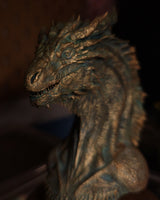
A little artisan's aside: Vhagar, Caraxes, Syrax, and even the Cannibal, who is still waiting for its appearance on screen, have their busts in my studio. I 3D print them and then paint them by hand, 12 cm tall with an aged bronze patina, along with Balerion and Dreamfyre. If you want to see them up close: the mini dragon busts from the studio.
The battle of the Gullet: what differences between the series and the book?
The battle of the Gullet is one of the major events of the Dance of the Dragons.
It pits the naval and aerial forces engaged in the conflict around Dragonstone and House Velaryon against each other.
In Fire & Blood, this battle has considerable consequences for Rhaenyra and her allies.
Season 3 changes the role of Rhaena and Sheepstealer
In the series, Rhaena and Sheepstealer participate in the events surrounding this battle.
Rhaena's lack of control over her dragon causes a dangerous situation that indirectly contributes to Jacaerys Velaryon's death.
This version differs significantly from the book, in which Nettles and Sheepstealer do not play this role.
The change allows the writers to link Jacaerys's tragedy to Rhaena's personal development.
But it also changes the responsibility of several characters and the political consequences of the battle.
The battle of Tumbleton: a different betrayal in season 3
The battle of Tumbleton, called Battle of Tumbleton in English, represents another major example of the liberties taken by HBO.
In Fire & Blood, dragonriders Hugh Hammer and Ulf the White betray Rhaenyra's forces during this confrontation.
Their dragons, Vermithor and Silverwing, then become decisive elements of the battle.
In the series, Hugh and Ulf do not make the same decisions
The third season significantly changes this betrayal.
Ulf turns against his former allies, while Hugh does not participate in the same way in the change of sides.
His story is more linked to his family and the human consequences of the war.
Daemon Targaryen also participates in the battle in the series, while he does not play this role in the book.
These changes allow main characters to be placed at the center of the action, but they considerably transform the course of events.
The prophecy of the Prince That Was Promised: an invention of the series?
One of the most important differences concerns the prophecy related to Aegon the Conqueror.
From the first season, Viserys reveals to Rhaenyra that Aegon had undertaken the conquest of Westeros after dreaming of a threat from the North.
This prophecy, called The Song of Ice and Fire, establishes a direct link with the events of Game of Thrones.
A prophecy absent in this form in Fire & Blood
In the book, this secret transmission between Targaryen rulers is not told in this way.
The series therefore uses the prophecy to give an additional dimension to Rhaenyra's ambitions.
In the third season, this idea becomes even more important when Rhaenyra presents herself as the figure foretold by the prophecy.
However, it is important to distinguish this television interpretation from the literary universe: George R. R. Martin himself has suggested that Aegon the Conqueror may have been motivated by a prophetic vision.
The difference therefore lies mainly in how the series incorporates this revelation into Rhaenyra's story.
Why does George R. R. Martin criticize certain changes in House of the Dragon?
George R. R. Martin has regularly expressed his interest in the series and praised certain aspects of its adaptation.
However, he has also made his disagreement known regarding several script decisions.
In September 2024, the writer published a post dedicated to the possible consequences of removing Prince Maelor.
His main complaint concerned the domino effect caused by certain changes.
In a story as complex as the Dance of the Dragons, removing a minor character can change several important events occurring much later.
Should an adaptation be completely faithful to the book?
The question divides viewers.
For some readers, the changes made to House of the Dragon weaken the coherence of the original story.
Others, on the contrary, appreciate the character development and the opportunity to discover a different interpretation of the chronicles of Westeros.
Ryan Condal defended this approach by reminding us that Fire & Blood itself is made up of contradictory accounts.
The series thus offers a version of events rather than a literal reproduction of the text.
Nevertheless, certain changes, such as the disappearance of Nettles or the transformation of the Battle of the Gullet, go far beyond the simple choice between several historical accounts.
Should you read Fire & Blood before watching House of the Dragon?
It is not necessary to have read Fire & Blood to understand House of the Dragon.
The series gradually introduces the characters, the different branches of the Targaryen family, and the political stakes of the succession.
On the other hand, reading Fire & Blood allows you to discover a much broader version of the history of the Targaryens.
The book contains a lot of information about the dragons, political alliances, minor characters, and events that are not directly shown on screen.
It also offers a different reading experience thanks to its contradictory accounts.
However, beware: the book tells the entire Dance of the Dragons and therefore reveals the events that the fourth season still has to adapt.
If you want to discover the conclusion of the series without spoilers, it is better to wait for its broadcast before finishing the relevant chapters.
House of the Dragon Season 4: Will the series stray from the books again?
The fourth season of House of the Dragon, scheduled for 2028, will be the conclusion of the HBO series.
After three seasons, several major changes have already altered the trajectories of certain characters.
The disappearance of Nettles, Rhaena's role, the changes regarding Helaena, and the new version of the Battle of the Gullet could notably have consequences on the final events.
It is therefore likely that the series will continue to offer its own interpretation of the Dance of the Dragons.
However, no official information yet allows us to determine precisely which scenes from the book will be kept or changed in the final season.
Readers of Fire & Blood know the broad outlines of the conclusion, but how HBO will choose to adapt them remains to be seen.

The sculptor's gaze
Sheepstealer, at the heart of the biggest change
Sheepstealer is at the heart of one of the biggest changes in the series. My figurine The Sheepstealer V2 is directly inspired by the concept art of House of the Dragon, reworked with my friend Kamil: a 30 cm wild dragon, brown scales, and yellow eyes, all hand-painted.
Conclusion: House of the Dragon or Fire & Blood, which version to discover?
House of the Dragon and Fire & Blood tell the same war, but not always the same story.
The HBO series prioritizes the emotional development of the characters, spectacular battles, and a more direct narrative.
George R. R. Martin's book takes a historical approach, in which the contradictory accounts leave a great deal of room for doubt and interpretation.
Certain differences, such as the friendship between Alicent and Rhaenyra, allow us to enrich the relationships between the characters.
Others, notably the disappearance of Nettles or the changes made to the major battles, transform the original story much more deeply.
For dragon enthusiasts, both works remain particularly interesting: the series allows you to visually discover creatures like Vhagar, Caraxes, or Vermithor, while the book delves deeper into their history and their place in the Targaryen dynasty.
And you, do you prefer the version of House of the Dragon offered by HBO or the one told in Fire & Blood?
Sources and references
Sources consulted for this update on November 23, 2026.
-
George R. R. Martin — Fire & Blood (Fire & Blood), 2018. Original work telling the history of the Targaryens and the Dance of the Dragons.
-
Esquire — Every Major Change from the Book in House of the Dragon Season 3 — analysis of the differences in the third season and interview with Ryan Condal, August 2026.
-
TheWrap — Here's What House of the Dragon Season 3 Changed From the Book — detailed comparison of Season 3 with Fire & Blood, August 2026.
-
GamesRadar+ — House of the Dragon Season 3 Showrunner Explains Why Rhaena Replaces Nettles — writers' explanations regarding Sheepstealer and Rhaena.
-
The Guardian — George R. R. Martin Criticises House of the Dragon Plot Changes — author's disagreements regarding Maelor and the script changes, September 2024.

From the studio to your library
The mini dragon busts
12 cm, antique bronze finish, hand-painted. They don’t come from the saga, but they fit right in between two fantasy novels.
€50 · shipped within 3 business days
View the mini bustsEnter the lair
12 free HD wallpapers upon registration
English newsletter, approximately twice a month. One-click unsubscribe.
About the author
Margaux 3D prints and hand-paints dragons in her workshop, L'Antre du dragon d'airain.
Leave a comment